Why Multimeter Selection Matters
In Indian industrial environments — from manufacturing plant maintenance to EPC project commissioning — a multimeter is the most-used electrical test instrument. Choosing the wrong one can mean inaccurate readings on VFD-driven motors, unsafe operation near high-voltage switchgear, or wasted money on features you will never use.
Hioki multimeters are built for professional use and the range spans from compact pocket testers to 60,000-count laboratory-grade instruments. This guide helps you navigate the selection.
Step 1: Understand CAT Safety Ratings
In India, IEC 61010 CAT ratings are mandatory for any multimeter used near industrial electrical systems. The categories define the environment where the instrument can be safely used:
- CAT II — Household appliances and portable equipment. Not suitable for panel work.
- CAT III — Distribution panels, junction boxes, fixed installation wiring. Suitable for most industrial maintenance work.
- CAT IV — Utility connections, incoming supply, substation work. Required for work on the supply side of main panels.
The Hioki DT4223 and DT4224 are rated CAT III 600V / CAT II 1000V — appropriate for the majority of industrial panel and motor maintenance work in India. The DT4252 and DT4253 extend to CAT III 1000V for higher-voltage environments.
Step 2: True RMS vs Average Responding
If you work on systems with Variable Frequency Drives (VFDs), soft starters, UPS systems, or any non-linear load — you must use a True RMS multimeter. Average-responding meters give errors of 30–50% on distorted waveforms.
All Hioki DT42 series multimeters include True RMS measurement. For basic resistive loads or simple AC utility checks, an average-responding instrument suffices — but in modern Indian industry, VFDs are ubiquitous, making True RMS effectively mandatory.
Step 3: Count Resolution
The count display tells you the resolution of the reading. Common options:
- 4000 count — Entry level. 400V range shows 0.1V steps. Fine for basic site checks.
- 6000 count — Standard professional. Hioki DT4223/DT4224 use 6000-count displays.
- 60,000 count — High precision. Hioki DT4281/DT4282. For calibration labs, R&D, or precision energy work.
📐 Hioki DT4281 — 60,000 Count High-Resolution Multimeter
View ProductStep 4: Solar PV Applications
India's rapid solar capacity addition has created a specific requirement: multimeters rated for 2000V DC. Standard 1000V instruments cannot be used safely on the high-voltage DC strings of utility-scale solar plants.
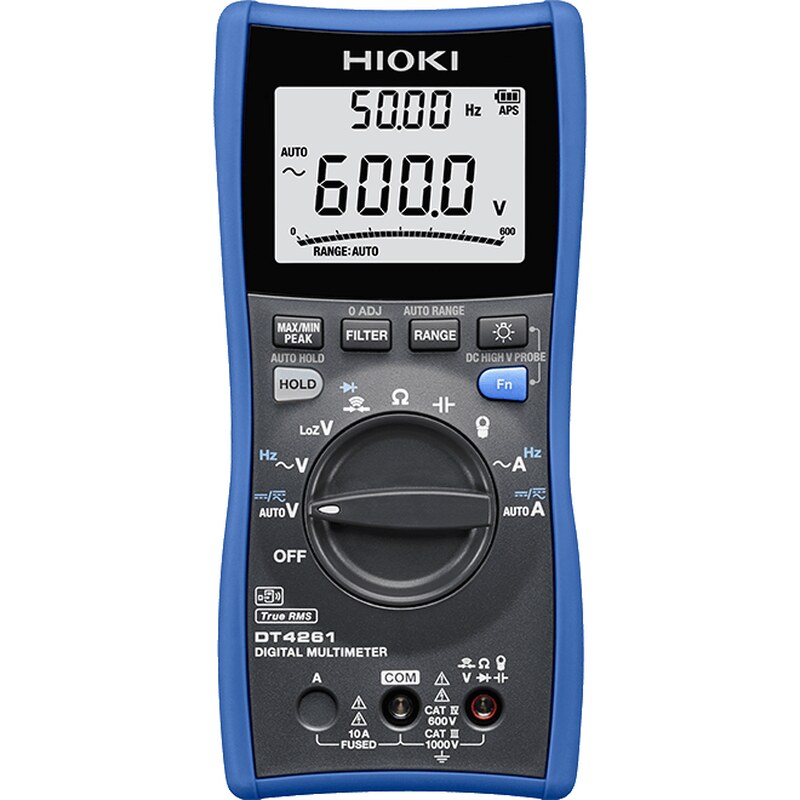
The Hioki DT4261 is specifically designed for solar PV systems, rated for 2000V DC measurement with a low-pass filter to handle inverter-generated noise — making it the recommended choice for O&M teams at solar plants.
☀️ Hioki DT4261 — 2000V Solar PV Multimeter
View ProductStep 5: Connectivity and Data Logging
For condition monitoring and trend analysis, Hioki offers Bluetooth-enabled multimeters (DT4256, DT4282) that pair with the GENNECT app. This is valuable for trending power quality parameters over time without manually recording readings.
Recommended Models by Application
- Site electrician, panel work: Hioki DT4223 or DT4224
- Maintenance engineer, motors + VFDs: Hioki DT4253 or DT4255
- Solar PV O&M: Hioki DT4261
- Calibration lab / R&D: Hioki DT4281 or DT4282
- Substation / utility work: Hioki DT4252
Conclusion
The right Hioki multimeter depends on your application voltage, the type of loads you measure, the safety category required, and whether you need data logging. Industrial Supply Syndicate stocks the complete Hioki DT-series range and can help you select the correct instrument for your specific requirement. Contact us for a formal quotation with GST invoice.